

 iscover
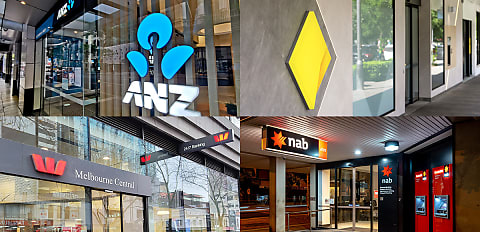

The new Monthly Authorised Deposit-taking Institution Statistics from the Australian Prudential Regulation Authority (APRA) shows that National Australia Bank (NAB) has maintained its lead in the sector, with a total of $267.5 billion in loans to non-financial businesses.
The bank added $3.6 billion over the month (+1.4 per cent) and $29.4 billion over the year (+12.3 per cent).
That kept NAB comfortably ahead of Commonwealth Bank of Australia (CBA), which held $237 billion in business lending following a $4.2 billion monthly increase (+1.8 per cent) and a $26.7 billion annual uplift (+12.7 per cent).
Westpac was not far behind on momentum, growing its non-financial business loan book to $202.9 billion after a $2.9 billion rise from February (+1.4 per cent) and a $27.1 billion jump year-on-year (+15.4 per cent), the strongest annual increase among the major banks.
Meanwhile, Australia and New Zealand Banking Group (ANZ) posted more moderate growth, with its non-financial business lending portfolio reaching $151.1 billion, up $1.5 billion month-on-month (+1 per cent) and $3.3 billion over the year (+2.3 per cent).
Grip on market share slowly tightens
APRA’s data also show that the major banks have further tightened their grip on Australia’s business lending market.
Overall, APRA’s March figures put total ADI lending to non-financial businesses at approximately $1.224 trillion, with the big four banks accounting for 70.1 per cent of that market or roughly $858.5 billion.

NAB commands 21.8 per cent of market share, CBA 19.3 per cent, Westpac 16.6 per cent and ANZ 12.3 per cent.
In dollar terms, the big four added $12.2 billion in loans to non-financial businesses between February and March, accounting for almost 79 per cent of all net monthly growth across the ADI sector.
Over the longer term, the big four have gradually tightened their grip on the business lending market. In March 2025, the major banks held 69.2 per cent of total ADI lending to non-financial businesses, up from 69.1 per cent in March 2021.
Results mixed among the non-majors
Outside the big four, international institutional lenders continued to feature prominently among the largest providers of business credit, although results were more mixed.
Sumitomo Mitsui Banking Corporation remained the fifth-largest lender to non-financial businesses with $23.7 billion, despite seeing balances fall $146.5 million over the month (-0.6 per cent) and $1.9 billion over the year (-7.5 per cent), making it the only lender in the top 10 to post an annual contraction.
Bank of China continued to build its commercial book, rising to $22.9 billion after adding $539.2 million month-on-month (+2.4 per cent) and $2.3 billion year-on-year (+11.1 per cent).
Macquarie Bank was broadly flat over the month at $22.5 billion, increasing by just $4.6 million, but remained $2.35 billion ahead of March last year (+11.7 per cent).
Further down the table, agri-lender Rabobank Australia grew its non-financial business lending to $22.47 billion, up $454.7 million from February (+2.1 per cent) and $979.2 million over the year (+4.6 per cent).
Japanese lenders MUFG Bank and Mizuho Bank rounded out the top 10.
MUFG’s business loan book slipped $579.5 million over the month (-2.8 per cent) to $20.4 billion, though it remained $1.38 billion higher year-on-year (+7.3 per cent), while Mizuho declined $362.7 million from February (-2 per cent) to $18.1 billion, but still posted a $2.27 billion annual increase (+14.3 per cent).
APRA's data also showed that investor lending is gathering pace again, with lenders such as Macquarie Bank and ING Bank Australia outstripping the majors as banks sharpen their focus on the investment segment.
The analysis, published on Broker Daily’s sister brand, The Adviser, also revealed investor loan growth is now outpacing owner-occupier lending across much of the market.
[Related: Finance access emerges as top hurdle for SME growth]
 Want to see more stories from trusted news sources?
Make Broker Daily a preferred news source on Google.
